

Not long ago, choosing a light bulb was relatively simple. Most homes used traditional tungsten incandescent bulbs, typically 40W or 60W for general lighting, 100W for brighter spaces, or 25W decorative candle bulbs. In the UK, these were most commonly fitted with bayonet caps (BC). The familiar warm glow of incandescent lighting was something we all recognised.
Fast forward to today and we have a dazzling array of options powered by LEDs. We measure the bulb’s brightness in lumens and its colour in Kelvin (K), and then there’s CRI (Colour Rendering Index). So let’s dig into what all this means when choosing a light bulb.
Let’s start simple with the bulb fittings or “caps” most commonly used in wall lights and pendant lights.
Fittings and caps
Bulb caps are typically either Bayonet Cap (BC) or Edison Screw (ES) and are available in different diameters.
The “bayonet cap” (also known as BC or B22 cap), with its familiar “push and twist” action, is used on most standard light bulbs. It is 22mm in diameter with two locating lugs. A smaller diameter variant, the “small bayonet cap” (SBC or B15), is very similar but only 15mm across.
The “Edison Screw cap“, or “ES” lamp fitting is used worldwide. The most popular E27 fitting is 27mm in diameter and is widely used in the UK and Europe. The smaller E14 variant is known as SES or “Small Edison Screw”, which is often used for smaller decorative fittings, chandeliers, and appliance light bulbs. It has a diameter of 14mm.
How bright is your bulb?
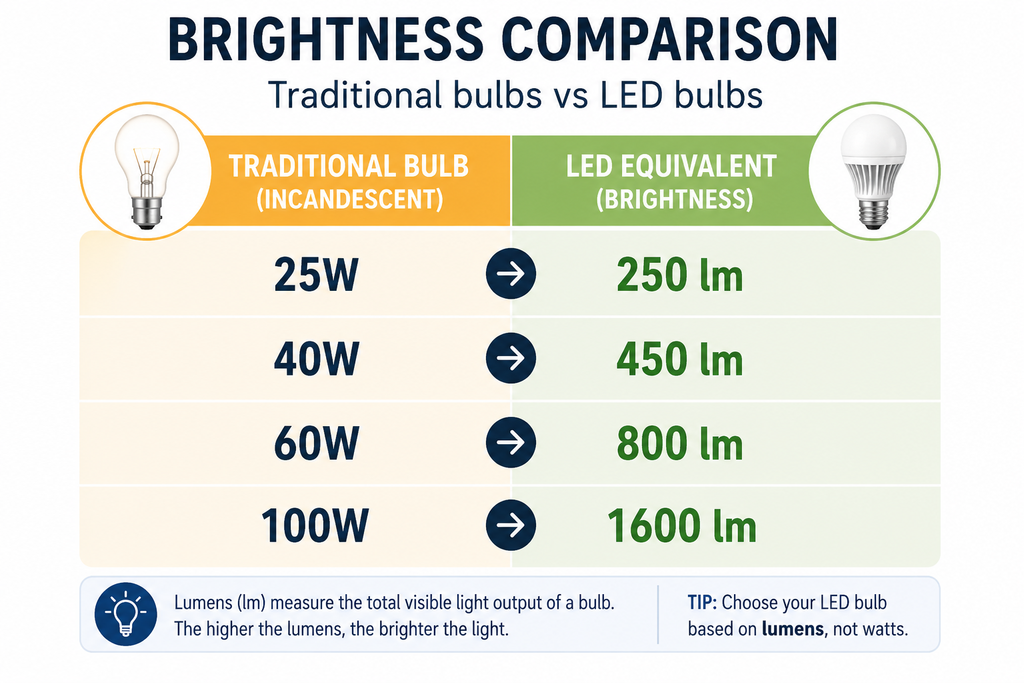
The brightness of a bulb is measured in lumens (lm). This is a measure of the total visible light output; it’s the most accurate way to determine a bulb’s brightness. LED bulbs are highly efficient, so wattage is no longer a reliable measure of brightness. But it’s still helpful to understand the ‘translation’ from incandescent bulb wattage to lumens.
- 25W equivalent is 230 – 270 lumens
- 40W equivalent is 440 – 460 lumens
- 60W equivalent is 800 – 850 lumens
- 100W equivalent is 1500 – 1600 lumens
These are general ranges to use as guidance. And of course, the good news for our pockets is that the wattage of these LED bulbs is a fraction of the old incandescent bulbs and cost less to
The colour temperature
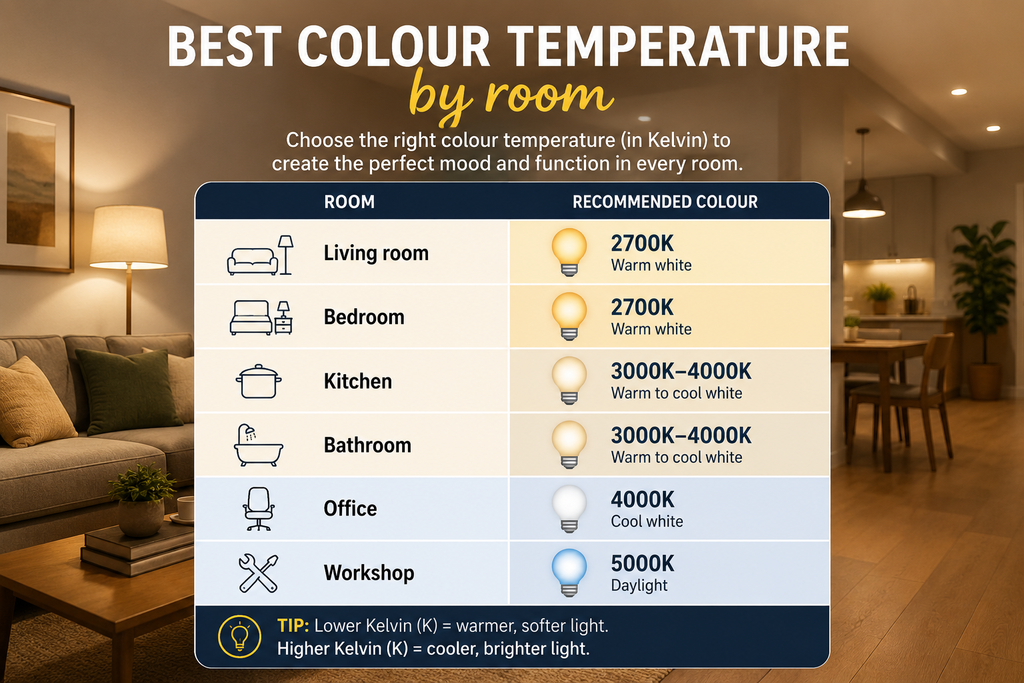
Next on the list is the colour temperature, which is measured in Kelvin (K); lower values indicate a “warmer” (more amber) light, higher values indicate a “cooler” (bluer) light. Selecting the correct colour temperature enhances a room’s aesthetic and functionality.
2000K to 2200K is at the warm end of the scale, often described as extra-warm white, giving a candlelight-like glow for intimate spaces.
2700K is warm white; the same as a traditional incandescent light bulb. This lighting offers a familiar and comforting glow. It suits spaces where warmth and relaxation are prioritised, like living rooms.
4000K is cool white; ideal for functional areas requiring clarity. Kitchens or offices often benefit from this bright, energising light. It replicates natural daylight more closely.
5000K to 6500K replicates daylight, delivering excellent brightness. These temperatures simulate natural outdoor light, making them perfect for reading or crafting. They maximise visibility. While this colour temperature replicates daylight, many people may find it feels ‘cold’ as we are so used to the traditional warmth of incandescent bulbs. These colour temperatures are more commonly used in workshops, garages, craft rooms, or task lighting than in living spaces.
CRI – Colour Rendering Index
Colour Rendering Index (CRI) is a measurement of how natural colours render under an artificial white light source when compared with sunlight. It is a scale from 0 to 100 that measures how accurately an artificial light source reveals the true colours of objects compared to natural sunlight. With low CRI lighting a vibrant red apple will look a muddy brown, or you may not be able to tell the difference between your black and navy t-shirts.
- 100 is the gold standard. Like natural sunlight, this provides perfect colour accuracy.
- 90+ is rated excellent. Ideal for art studios, retail displays, makeup vanities, and kitchens.
- 80+ is good. This is generally considered the standard minimum for most homes, general offices, and workspaces.
When shopping for bulbs, check the specifications. If you want your home or workspace to look vibrant and natural, look for bulbs or fixtures with a CRI of 90 or higher.
Dimmers
It’s easy to get caught out by this, bear in mind that not all LED bulbs are dimmable. If you are using a dimmer switch, check that both the bulb and the dimmer are compatible with LED lighting.
Conclusion
Good lighting isn’t just about choosing the right bulb. How you combine different light sources also makes a big difference. See our guide to The 5–7 Rule: The Secret to Better Lighting at Home.
We hope this guide has helped explain the key terminology used for LED bulbs and lighting. Understanding brightness, colour temperature, fittings, and CRI will make it easier to choose the right bulb for every room and application in your home.




Leave a Reply
You must be logged in to post a comment.