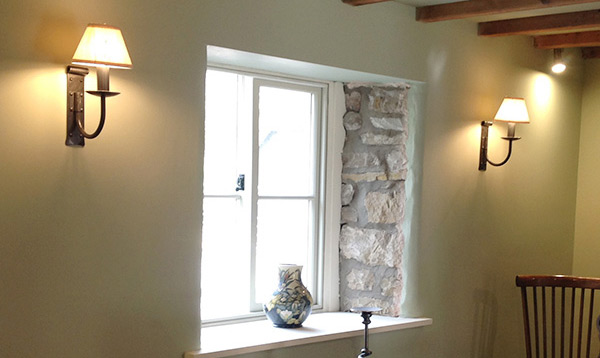

Most of us call it a wall light, a few call it a sconce or wall sconce. We thought it would be interesting to trace the heritage of today’s modern wall light.
The word sconce has a surprisingly layered history, reflecting both linguistic evolution and changes in interior design over centuries. Its origins can be traced back to the Middle Dutch word schans, meaning a protective structure or shield. This term later influenced the Old French esconce, referring to a lantern or a covering designed to protect a flame from wind. By the time the word entered Middle English in the 15th century, sconce had come to describe a fixed wall-mounted holder for candles or torches, in essence an early lighting fixture designed to shield and stabilise a flame.
In medieval times, sconces were practical necessities. They were often made of iron or wood and affixed to stone walls, holding candles that provided flickering, limited illumination. Their design prioritised function over form, though in wealthier households, sconces could be ornate, featuring decorative metalwork or carved details. The key idea remained consistent: a light source attached to a wall, often with some form of backing to reflect light and protect the wall from heat or soot. Also, mounting on the wall kept the flame away from the ceiling and made it easy to light and extinguish.
As lighting technology advanced, so did the sconce. The introduction of gas lighting in the 19th century transformed sconces into more efficient and brighter fixtures. Later, the advent of electricity in the late 19th and early 20th centuries revolutionised wall lighting entirely. Electric sconces retained the wall-mounted format but expanded in style, material, and purpose.


Today’s modern wall lights are direct descendants of these early sconces. While they no longer need to shield an open flame, the concept of a wall-mounted light fixture remains central. Contemporary designs range from minimalist LED strips to elaborate decorative pieces, blending functionality with aesthetics. The evolution of the sconce reflects broader shifts in technology and design, but its core purpose, bringing light to walls, has remained remarkably consistent across centuries.
Discover our range of hand forged wall lights.